there's a few recommended links here, but the above adverts may be more relevant for you.
Chichen Itza
Meeting the tour party was one part of the adventure, with people from
Canada, USA, Belgium, Britain, Australia and New Zealand, the variety was
there from the start. On our first day we travelled from Cancun to Chichen
Itza, an historical Mayan site. The 2 1/2 hour bus ride was one of relative
comfort, passengers can either sit back and view a movie, watch the scenery
flash by, chat to one another or enjoy a short siesta. Some of us managed
to accomplish all four. With bottled water and cameras at the ready, we
met our local Mexican guide for a tour of the site. Chichen Itza dates
back to beyond 800AD and there are several stunning temples and pyramids
to take your breath away in wonderment. As we listened to our guide, the
sophistication of the Mayans started to become apparent.
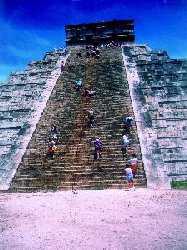 The main pyramid,
the Temple of Kukulklan, is a striking pyramid with steps leading to the
top from all four sides. With 91 steps on each side plus the top platform
the total of 365 equals the number of days in the year. The temple was
built with real mathematical precision, twice a year at the spring and
autumn equinoxes the shadows cause a large serpent to snake its way down
the northern staircase. Lasting nearly 3 1/2 hours, this phenomenon has
continued unchanged for 1200 years! Climbing to the top of the temple is
an experience not to be missed, the views are magnificent whilst the thought
that we are following in the footsteps of ancient priests and kings is
quite special.
The main pyramid,
the Temple of Kukulklan, is a striking pyramid with steps leading to the
top from all four sides. With 91 steps on each side plus the top platform
the total of 365 equals the number of days in the year. The temple was
built with real mathematical precision, twice a year at the spring and
autumn equinoxes the shadows cause a large serpent to snake its way down
the northern staircase. Lasting nearly 3 1/2 hours, this phenomenon has
continued unchanged for 1200 years! Climbing to the top of the temple is
an experience not to be missed, the views are magnificent whilst the thought
that we are following in the footsteps of ancient priests and kings is
quite special.
It's humbling to learn that the Mayans were such expert mathematicians
and astronomers. Their calendar for example exhibited a degree of accuracy
greater than the western worlds Gregorian and Julian calendars. In fact,
until we had the use of computers, we couldn't even replicate the Mayans
accuracy.
The Temple of The Warriors is a sight that, from high above the ground,
could easily be in Greece. With its large palace and multitude of stone
pillars, it demands a closer inspection. And yes, the images of Greece
are just as sharp from a few feet away. The reclining figure of the god-like
Chacmool with a sacrificial dish on his stomach is found here, definitely
another photo opportunity and yet another water stop. Mayan legend records
that this was one of the sites where human sacrifices took place. Walking
to the other main sacrificial area, we passed the Ball Court. It was here
that one of the earliest team sports was played out in front grandstands
filled with the ruling classes. Whilst there is some disagreement amongst
archaeologists, it is suspected that the leader of the winning team, and
sometimes also his team members, lost their lives following the game. Why,
we asked? Simple really, by leading the winning team and then submitting
to the sacrifice, the team leader was assured of being resurrected as a
god with eternal life and power. We next walked along what we quickly christened
the mercantile roadway to the sacred cenote (sacrificial pool). Chichen
Itza is the only Mayan site that we visited that allows traders to harass
the tourists. On each side of this ancient road are local and visiting
people of Mayan descent, selling everything from jewellery to woven fabrics
(from Guatemala) to woodcarvings. It was interesting to note that woodcarvings
can only be seen in two forms - just started or completely finished. I
still wonder where the factory is that makes the "real" carvings. On to
the cenote, once a pool of pure and sacred water. Part way through the
Mayan history, their religious beliefs changed radically. From being a
peaceful race that cherished life, they became a bloodthirsty race that
sacrificed thousands of their own people. Apparently this was not without
purpose. By offering up human sacrifices to their gods, the Mayans believed
that they could forestall the earth's next major catastrophe. Their history
records four or five such cataclysms, including a great flood not unlike
that recorded in the Bible. Preceded by earthquakes and massive volcanic
eruptions, this next major catastrophe is, according to the Mayan calendar,
timed for 24 December 2012. It's easy to scoff at this, until we are reminded
of the amazing accuracy of their calendar! There are numerous other temples
and palaces here at Chichen Itza, all built with precise orientation to
the sun, planets and stars and all of which are worth visiting and exploring.
Some of the sculptured faces raise significant questions. Who, for instance,
was the inspiration for the bearded white man, carved 500 years before
any white men supposedly came to the American continent?





Copyright: Martin Dabb 1997. All rights reserved.
jmdabb@bigpond.com
there's a few recommended links here, but the above adverts may be more relevant for you.